
Search Hawaii Bankruptcy Records
Hawaii bankruptcy records are federal court filings kept by the U.S. Bankruptcy Court for the District of Hawaii in Honolulu. Every bankruptcy case in the state runs through this one court. That holds true whether the debtor lives on Oahu, Maui, Kauai, the Big Island, or Molokai. You can search Hawaii bankruptcy records online through PACER, review files at public terminals in the Clerk's Office, or request paper and certified copies by email. This page walks through the main search tools, filing chapters, fees, and lookup methods tied to Hawaii bankruptcy records so you can find the case you need fast.
Hawaii Bankruptcy Records Overview
U.S. Bankruptcy Court for Hawaii
The United States Bankruptcy Court for the District of Hawaii handles every bankruptcy case filed in the state. The clerk sits at 1132 Bishop Street, Suite 250, in downtown Honolulu. You can reach the Clerk's Office by phone at (808) 522-8100. The court takes Chapter 7, Chapter 11, Chapter 12, and Chapter 13 cases from all Hawaiian islands. There is no branch on Maui, Kauai, Molokai, or the Big Island. Every debtor files here.
Bankruptcy is a federal matter. A state judge cannot rule on a bankruptcy case. Congress holds this power under Article I, Section 8 of the U.S. Constitution. The Bankruptcy Code sits in Title 11 of the United States Code, and the Federal Rules of Bankruptcy Procedure lay out how cases move through the court. Local Bankruptcy Rules fill in the details for the District of Hawaii. For a plain-language overview, see the court's page at hib.uscourts.gov/understanding-bankruptcy.
The court's main website is hib.uscourts.gov, where you can find news, hearing schedules, local rules, and Clerk's Office procedures.
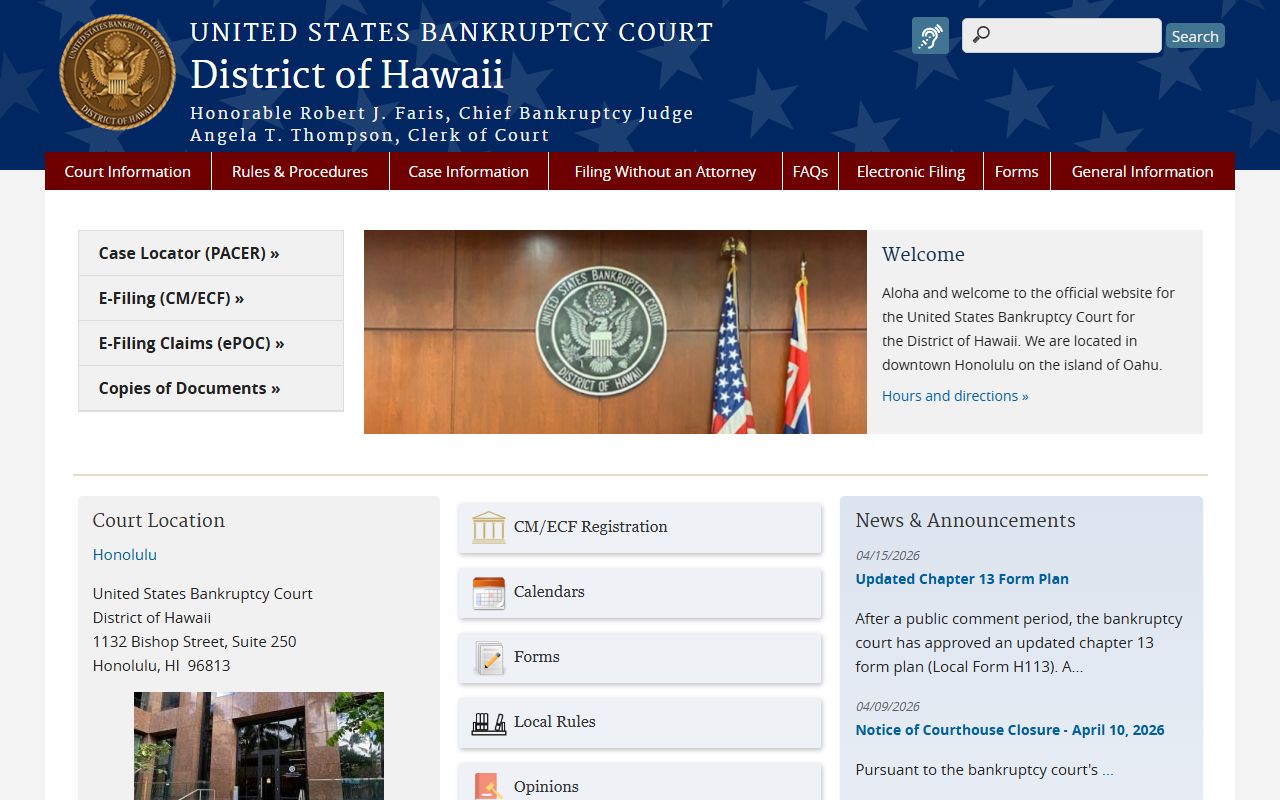
The homepage links to Case Locator (PACER), E-Filing (CM/ECF), E-Filing Claims (ePOC), and document copy services for Hawaii bankruptcy records.
Note: The Clerk's Office keeps no paper files. Hawaii bankruptcy records filed on or after January 1, 1998 exist only as electronic images.
How to Search Hawaii Bankruptcy Records
The fastest way to search Hawaii bankruptcy records is PACER. PACER stands for Public Access to Court Electronic Records. It is a national index kept by the federal judiciary. You can look up cases by party name, case number, or filing date across every U.S. Bankruptcy Court. Documents filed in Hawaii on or after January 1, 1998 show up on PACER. Older files may be stored at the San Francisco Federal Records Center.
To register for PACER, go to pacer.gov. Sign up is free. You can give a credit card for same-day access, or wait about a week to get login info by mail. PACER charges $0.10 per page with a $3.00 cap per document. Case Locator searches run across every federal court at once. PACER is open 24 hours a day, 7 days a week.
Lead-in to the PACER overview from the court:
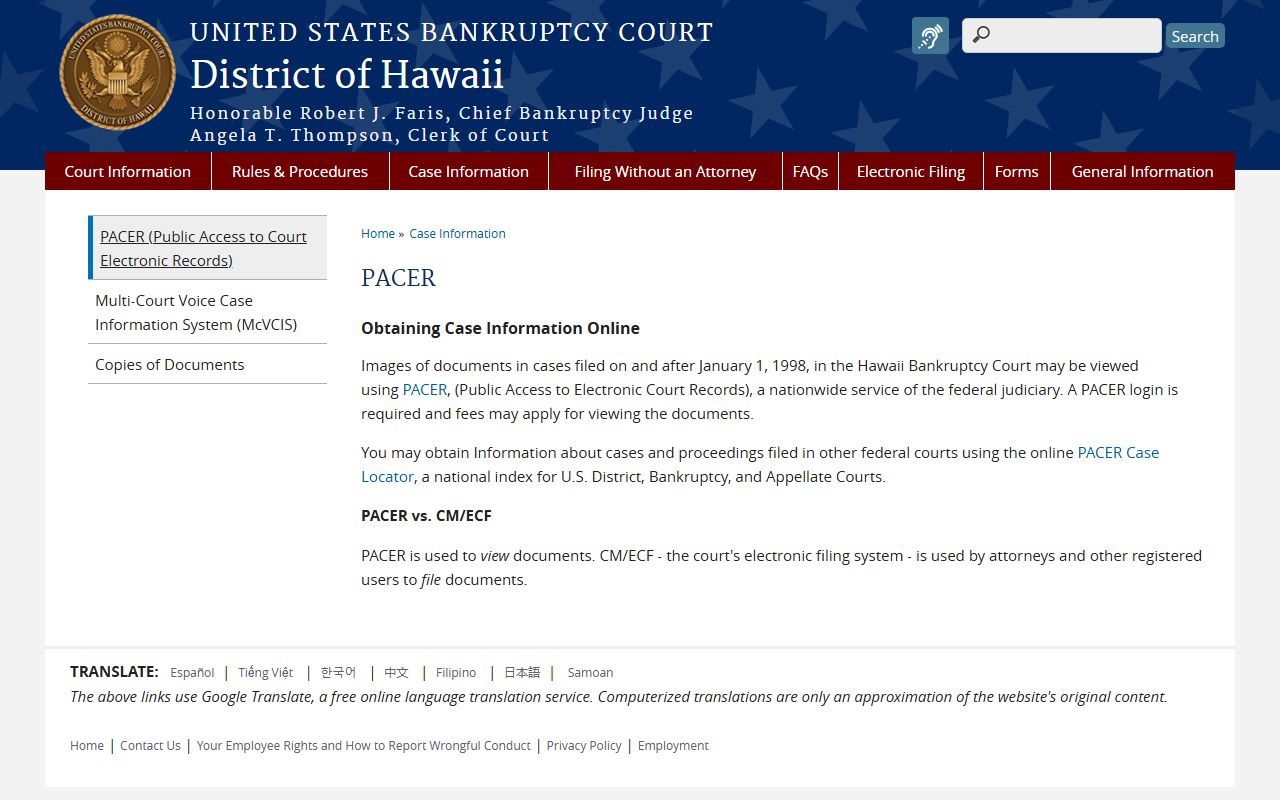
You can read the full PACER guide for the District of Hawaii at hib.uscourts.gov/pacer.
If you just want to confirm a filing, you can also use McVCIS (Multi-Court Voice Case Information System). It is a free voice phone service. Call and key in the debtor's last name or case number. The system reads back the basic case info. No login needed.
Types of Hawaii Bankruptcy Records
Hawaii bankruptcy records fall under four chapters. Each chapter has its own rules, fees, and forms. The right choice depends on the debtor's income, debts, and goals. Most filers pick either Chapter 7 or Chapter 13.
Chapter 7 is a liquidation. The trustee may sell non-exempt property to pay creditors. Most unsecured debts get discharged at the end. Chapter 11 is a reorganization used by businesses and some high-debt individuals. Chapter 12 is just for family farmers and family fishermen with regular income. Chapter 13 is a wage-earner repayment plan that lets the debtor keep property while paying creditors over three to five years.
The court's case information page explains how each chapter moves through the Hawaii bankruptcy records system:
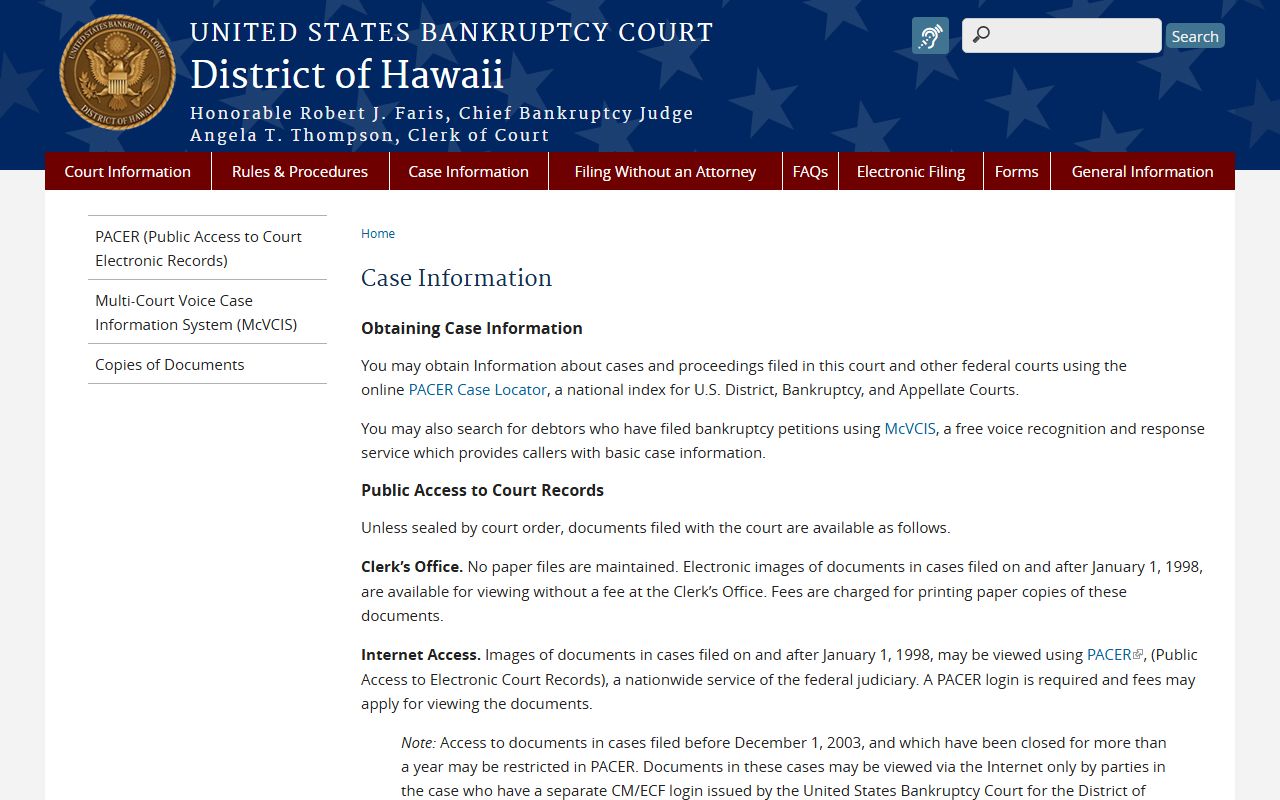
Read more at hib.uscourts.gov/case-information to see what documents show up in each chapter's file.
Chapter 7 Hawaii Bankruptcy Records
Chapter 7 is the most common bankruptcy chapter in Hawaii. The total filing fee is $338. That breaks down as a $245 filing fee, a $78 administrative fee, and a $15 trustee surcharge. Only money orders, cashier's checks, or online pay.gov payments are accepted. Personal checks and cash do not work. Debtors who cannot pay in installments can ask for a fee waiver if income falls below 150% of the federal poverty line, under 28 U.S.C. § 1930(f).
A Chapter 7 filing starts a Hawaii bankruptcy record that includes the Voluntary Petition (Form 101), a full creditor list, Schedules A/B through J, a Statement of Financial Affairs (Form 107), a Statement of Intention (Form 108), and the means test forms (122A-1 and 122A-2). All of this sits in the court file and shows up on PACER once docketed. The means test checks whether income is low enough to allow Chapter 7. If debts are mainly consumer debts, the test matters. If they are not, the test may not apply.
The full list of Chapter 7 forms and local filing requirements is here:
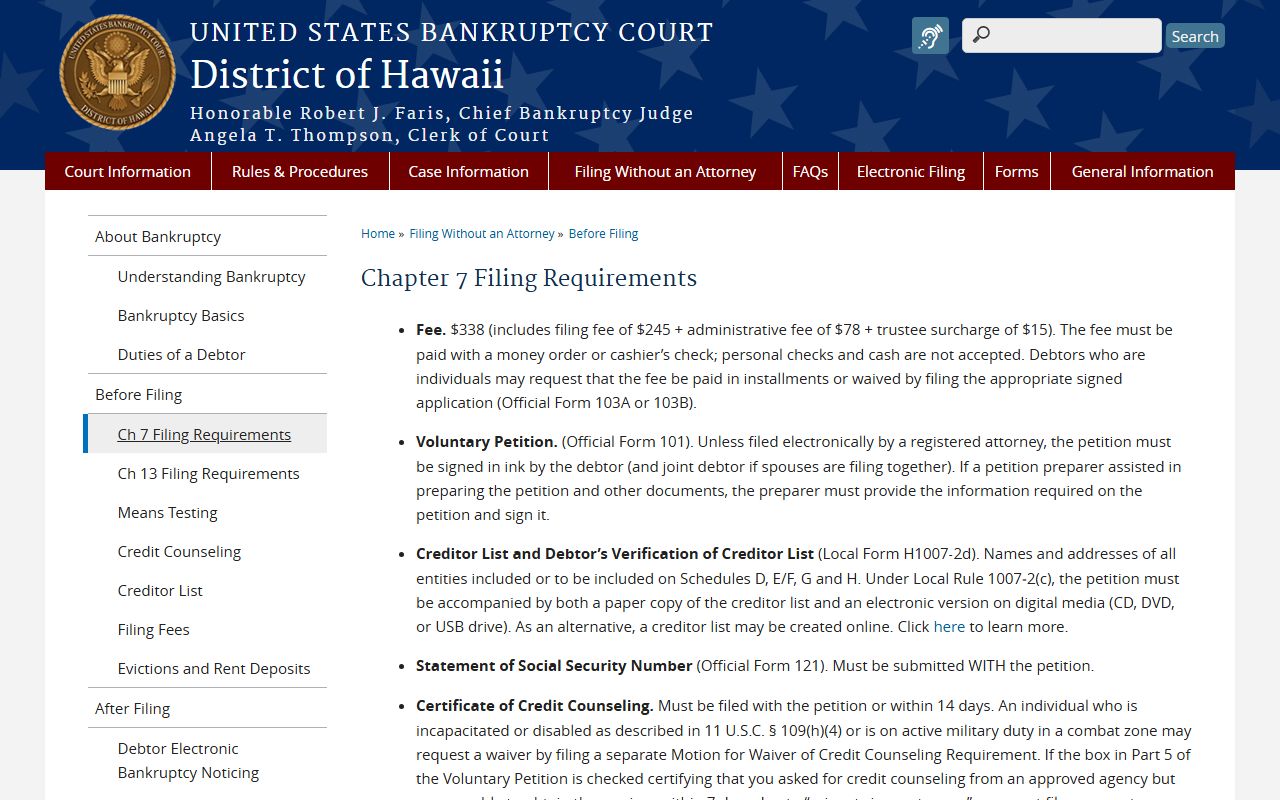
Full details on the Chapter 7 process for Hawaii bankruptcy records are at hib.uscourts.gov/chapter-7-filing-requirements.
Chapter 13 Hawaii Bankruptcy Records
Chapter 13 lets a debtor keep property while paying debts over time. The filing fee is $313 ($235 filing fee plus $78 administrative fee). The plan must run 3 or 5 years. The court must approve it. Eligibility caps apply to secured and unsecured debt under 11 U.S.C. § 109(e).
The Hawaii bankruptcy records for a Chapter 13 case include the Voluntary Petition, creditor list, schedules, Statement of Financial Affairs, the Chapter 13 Plan (Local Form H113), and Form 122C-1 (income and commitment period). Under Local Bankruptcy Rule 3015(h), the clerk sets a standard plan interest rate each January and July for secured-claim distributions under § 1325(a)(5)(B)(ii). Hearings on confirmation of the plan show up on the court calendar. Most creditor objections resolve before or at the confirmation hearing.
See the full list of Chapter 13 forms and filing steps here:
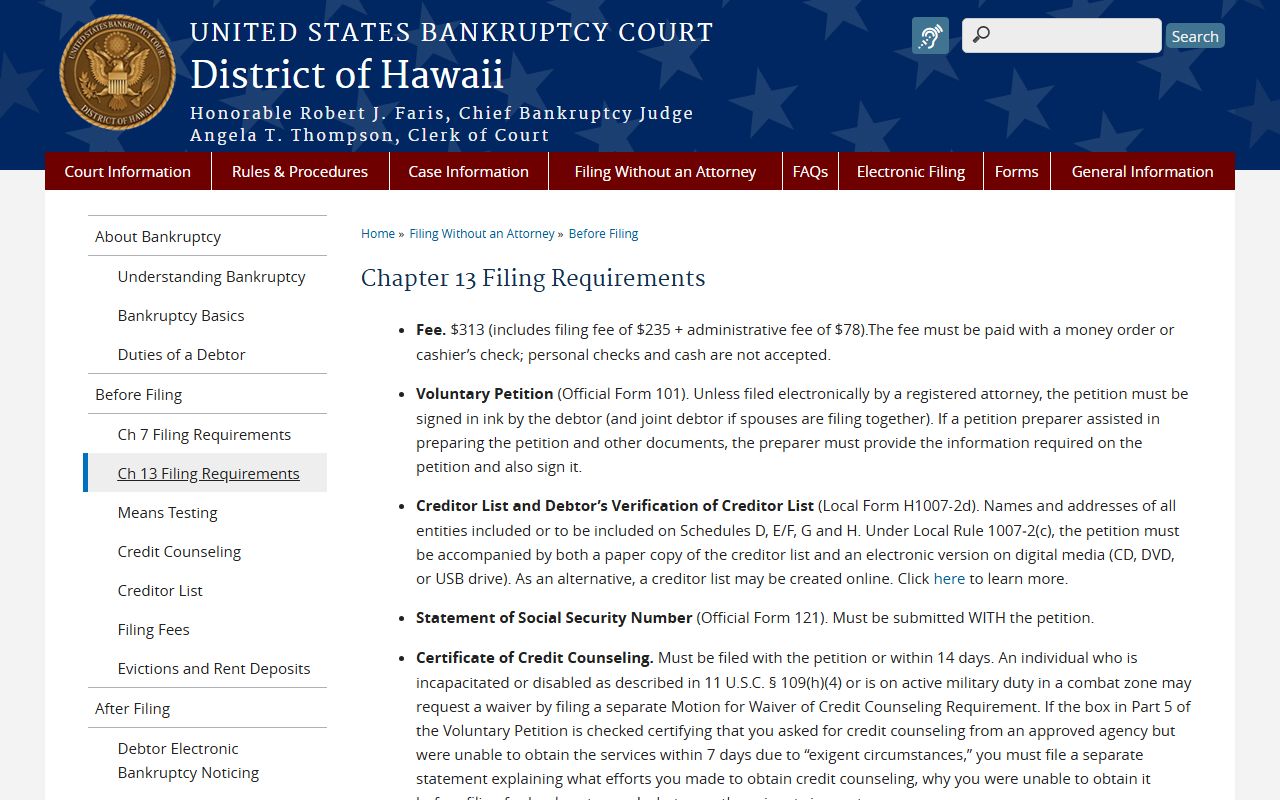
The court's full Chapter 13 checklist is at hib.uscourts.gov/chapter-13-filing-requirements.
Note: A discharge at the end of a Chapter 13 case does not wipe out domestic support, most student loans, certain taxes, or court-ordered restitution.
Filing Fees for Hawaii Bankruptcy Cases
Fees matter. Each chapter has its own price. The court publishes the full schedule online. Fees change from time to time, so check before filing.
Current filing fees for Hawaii bankruptcy records include:
- Chapter 7: $338 total
- Chapter 11: $1,738 total
- Chapter 12: $278 total
- Chapter 13: $313 total
Individual Chapter 7 debtors may ask to pay in installments, with the last payment due within 120 days of filing the petition. Under Chapters 12 and 13, the final installment is due within 14 days. Chapter 11 cases almost never get installment approval. A debtor below 150% of the federal poverty line may apply for a full waiver using Official Form 103B. Family size on the waiver application should match Schedule I.
Here is the court's filing fees page:
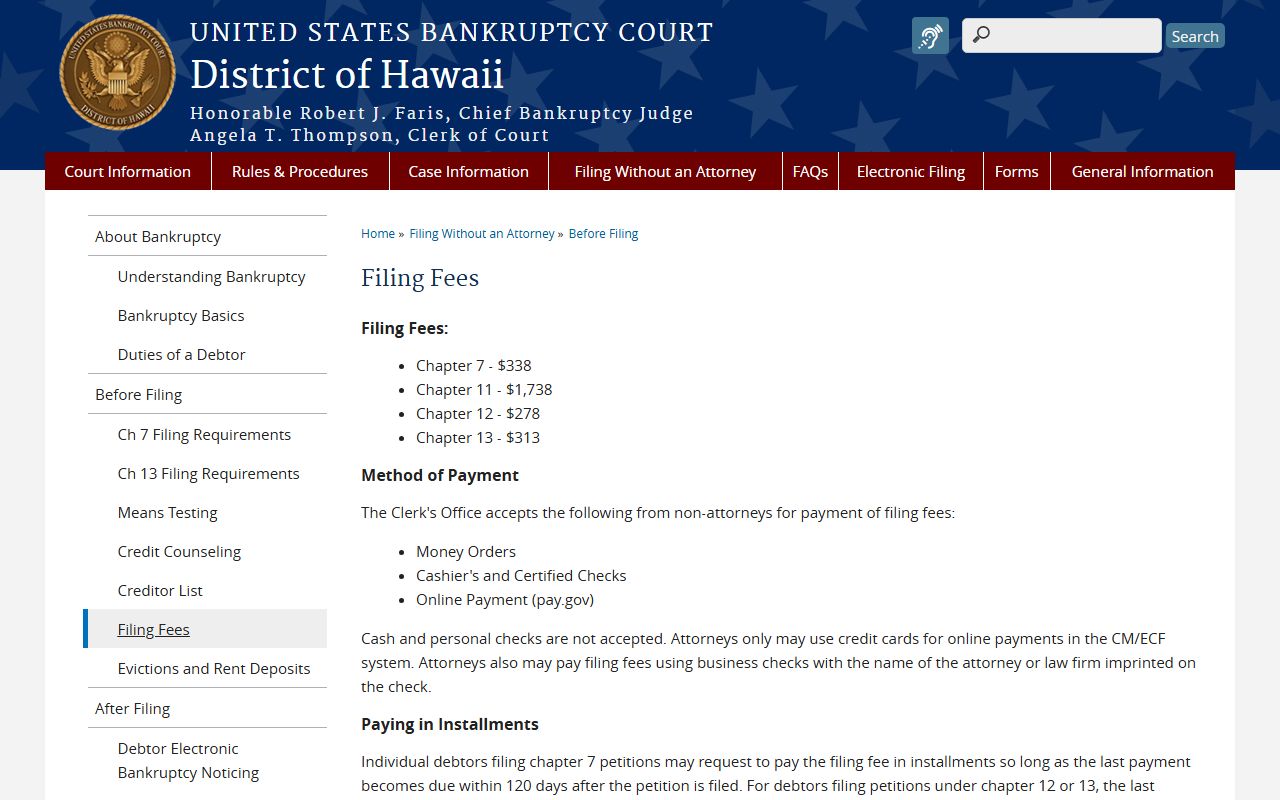
For the latest amounts and payment methods, check hib.uscourts.gov/filing-fees before you file.
Meeting of Creditors (341 Meeting)
Every bankruptcy case in Hawaii includes a meeting of creditors. People call this the "341 meeting" because section 341 of the Bankruptcy Code requires it. The trustee runs the meeting in a Chapter 7 or Chapter 13 case. A U.S. Trustee's rep runs it in most Chapter 11 cases. Joint debtors must both attend and answer questions under oath. Creditors can show up, but they do not have to. As of 2022, most 341 meetings in Hawaii happen over Zoom video.
Bankruptcy Rule 2003 sets the time frame. Chapter 7 meetings are held 21 to 40 days after the petition is filed. Chapter 13 meetings are held 21 to 50 days after filing. Debtors must mail photo ID and proof of Social Security number to the trustee at least 7 days before the meeting. A driver's license, state ID card, military ID, resident alien card, or passport works. The trustees assigned to Hawaii cases include Dane Field, Nima Ghazvini, Elizabeth Kane, and Richard Yanagi. Each trustee has a dedicated Zoom link and phone number posted on the court calendar page.
The 341 meeting page with trustee contact info is here:
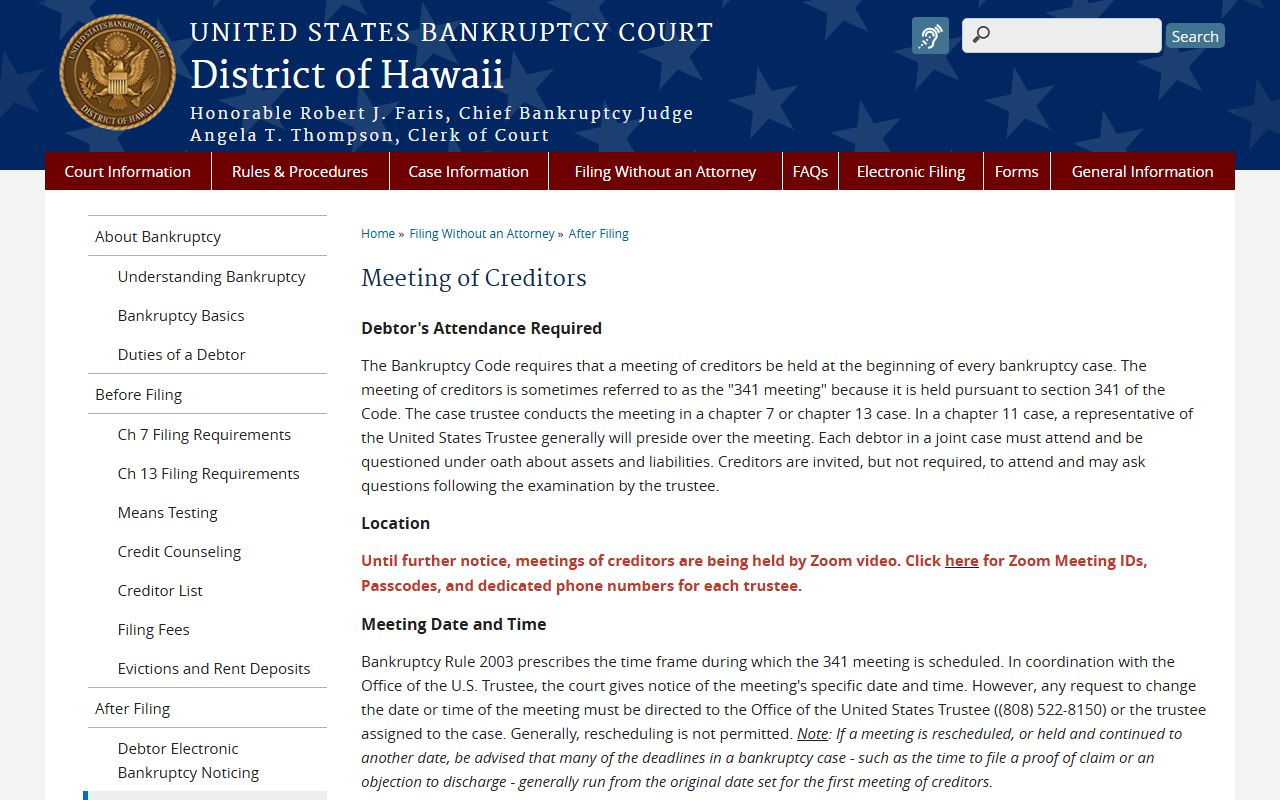
Full 341 meeting info sits at hib.uscourts.gov/meeting-creditors, and the U.S. Trustee program publishes national guidance at justice.gov/ust/moc.
Hawaii Bankruptcy Court Calendar and Hearings
The court posts a public calendar for hearings and meetings of creditors. Many hearings let parties appear by Zoom. Trials and evidentiary hearings are in person unless the judge orders otherwise. The Zoom meeting ID for general hearings is 161 789 3766 and the passcode is 1132. You can also call (833) 568-8864 toll-free and key in the same meeting ID.
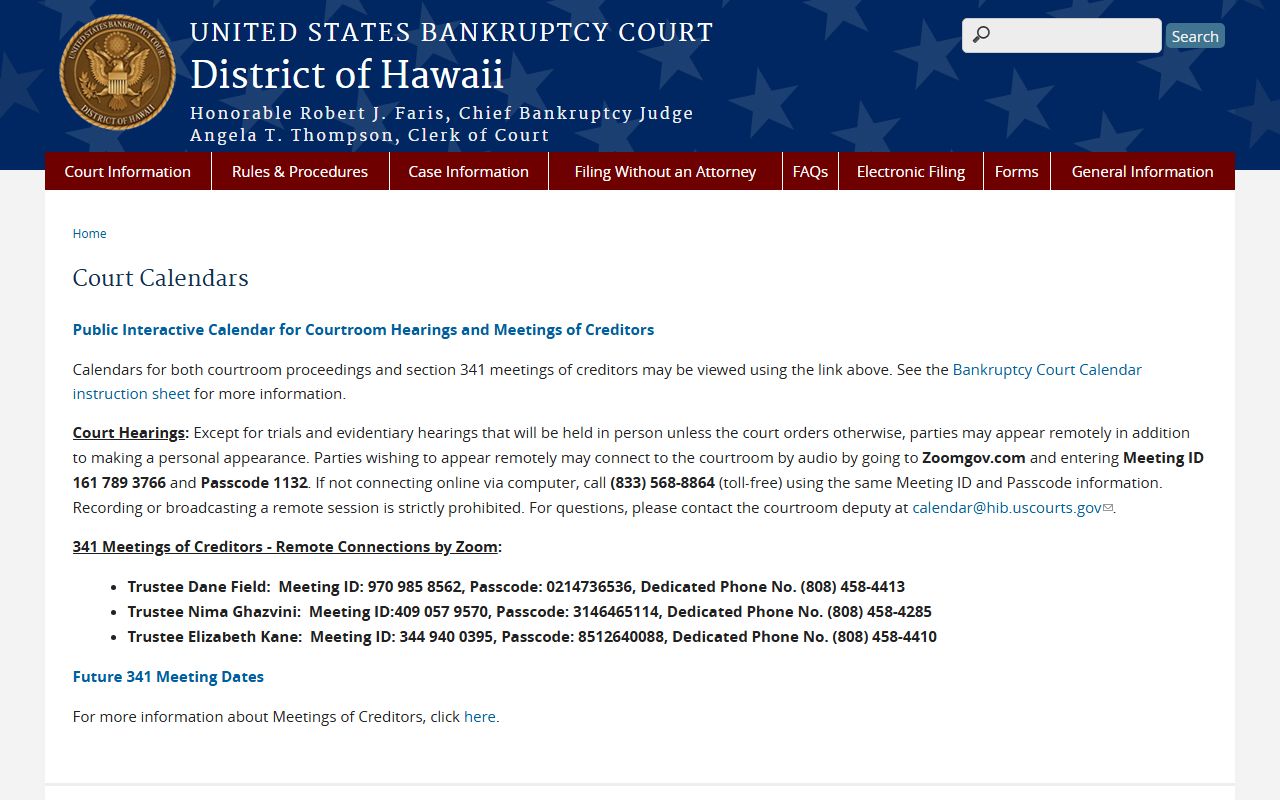
The full hearing calendar is at hib.uscourts.gov/court-calendars. Recording or broadcasting a remote session is banned. Email the courtroom deputy at calendar@hib.uscourts.gov with any hearing questions.
Getting Copies of Hawaii Bankruptcy Records
You can ask the Clerk's Office for plain or certified copies of any Hawaii bankruptcy records. Requests go to copies@hib.uscourts.gov, by phone to (808) 522-8100, or by mail to 1132 Bishop Street, Suite 250, Honolulu, HI 96813. Per-page copy fees apply. Certified copies carry the court seal and have a higher rate. The clerk sends an invoice first. Send payment by money order, cashier's check, or certified check. Cash and personal checks are not taken.
A debtor can ask for a scanned PDF copy of a document in their own case at no charge, so long as the request covers no more than two documents. Email the request from the debtor's address, list the case number and case title, and name the specific document. For a paper copy, regular copy fees still apply. Certified copies for banks, title companies, or registration in another federal court use Form 2650 and take extra processing time.
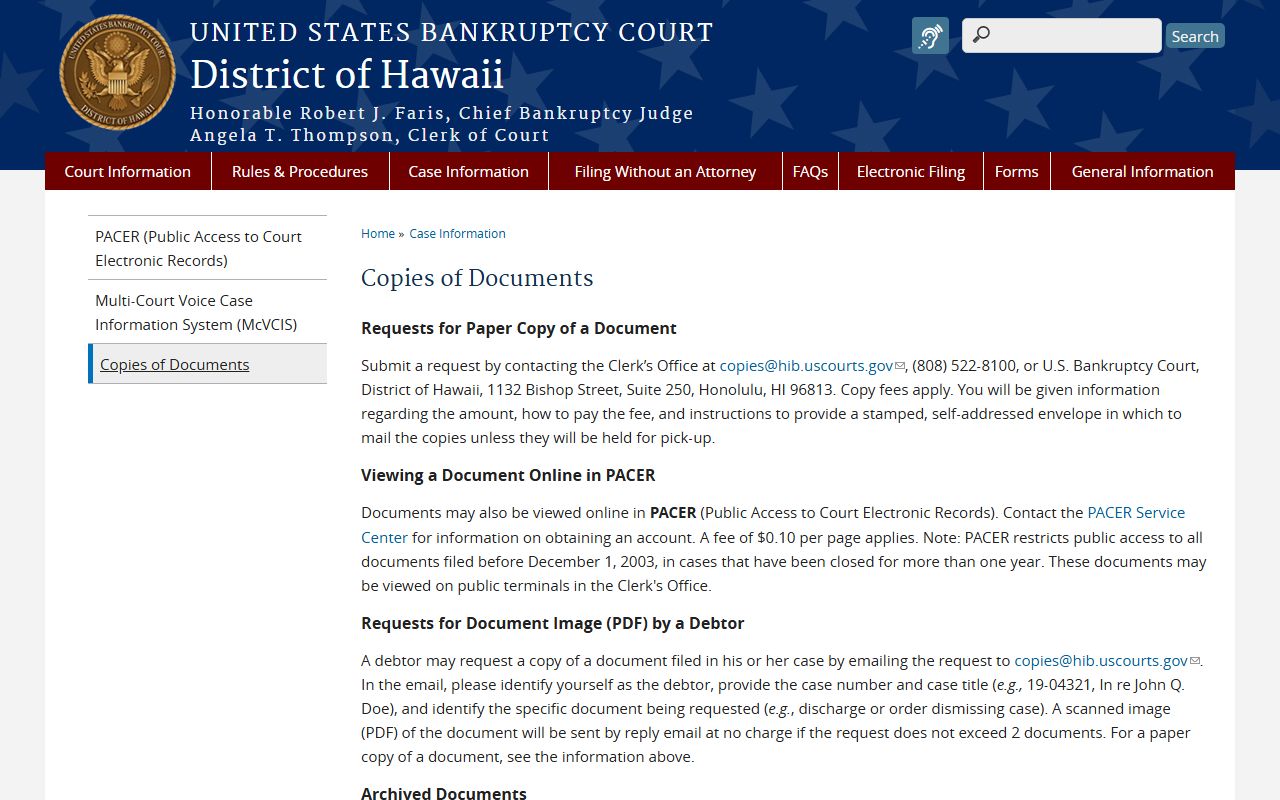
The full copy request page is at hib.uscourts.gov/copies-documents. If the case was filed before 1998, paper files may sit at the San Francisco Federal Records Center. Contact the Clerk's Office to get the Box, Location, and Transfer numbers you need to pull those files.
Forms for Hawaii Bankruptcy Records
The court uses both national Official Bankruptcy Forms and local Hawaii forms. National forms come from the Judicial Conference under Bankruptcy Rule 9009. Local forms include the H113 Chapter 13 Plan, H341dec (pay advices and tax returns for the 341 meeting), H1007-2d (creditor list verification), and many eOrder templates. All local forms are listed on the court's forms page.
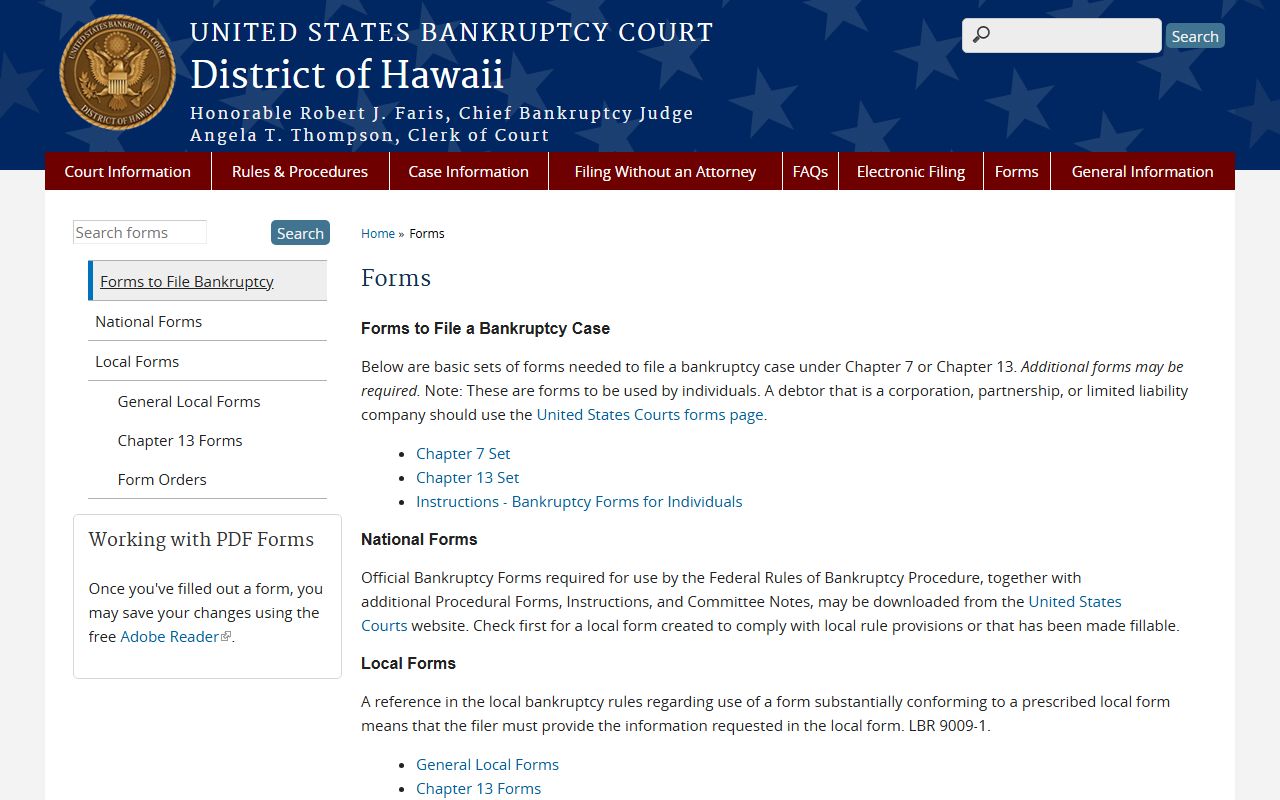
The full forms index is at hib.uscourts.gov/forms. Corporations, partnerships, and LLCs use the forms on uscourts.gov instead of the individual forms. The Proof of Claim form (Official Form 410) saw an update effective December 1, 2024.
eCourt Kokua and State Court Records
eCourt Kokua is the Hawaii State Judiciary's public access portal for state court cases. It covers traffic, District, Circuit, and Family (Adult) Court criminal and civil cases, Land Court, Tax Appeal Court, and appellate cases. It does not cover bankruptcy. Bankruptcy sits in federal court. Still, state court records can matter for a bankruptcy filer. Judgments, foreclosures, and garnishments show up there.
Case ID format in eCourt Kokua uses a 12-character code. The first digit is the circuit (1 for First Circuit on Oahu, 2 for Second on Maui, 3 for Third on the Big Island, 5 for Fifth on Kauai). The next character sets the court type. Two characters set the case type. Then come the year and sequence. Example: CR-15-1-5678 becomes 1PC151005678 in the system.
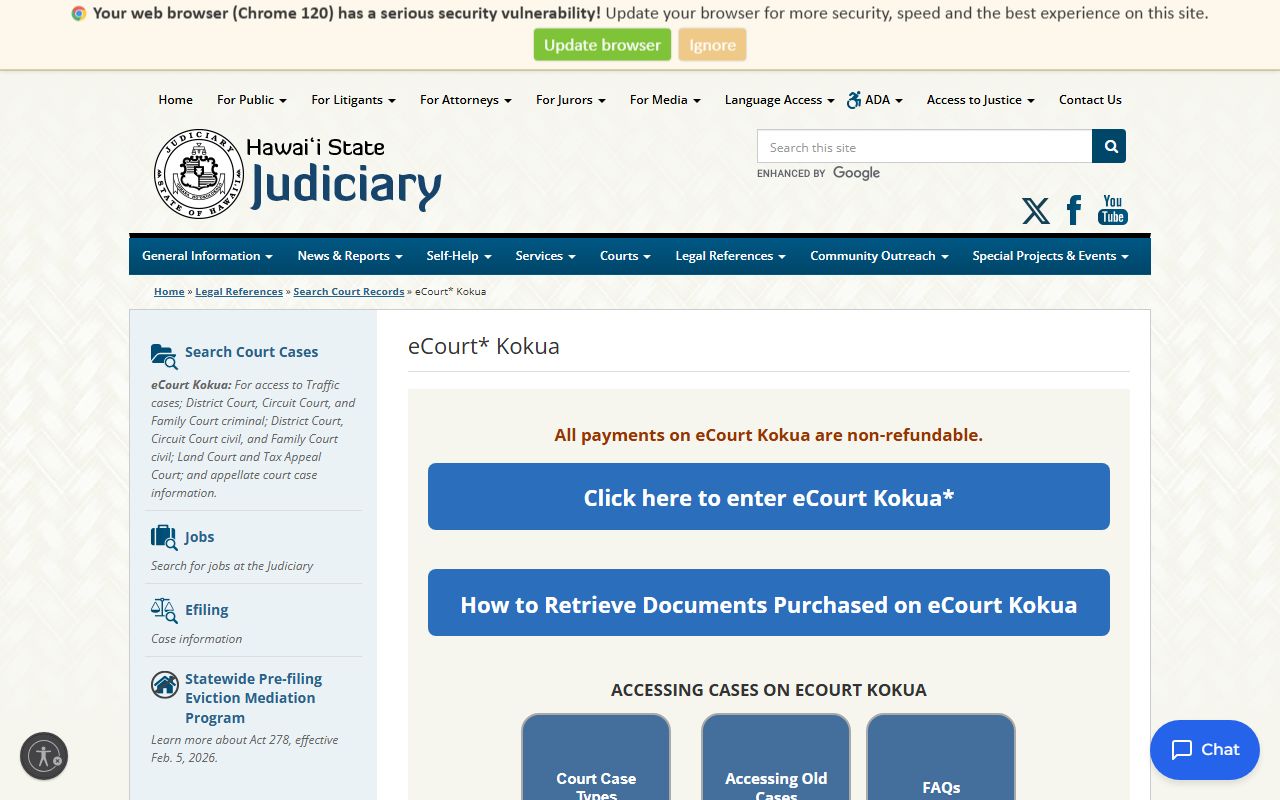
Search eCourt Kokua at courts.state.hi.us. JEFS (the Judiciary Electronic Filing and Service System) is the e-filing side of the system.
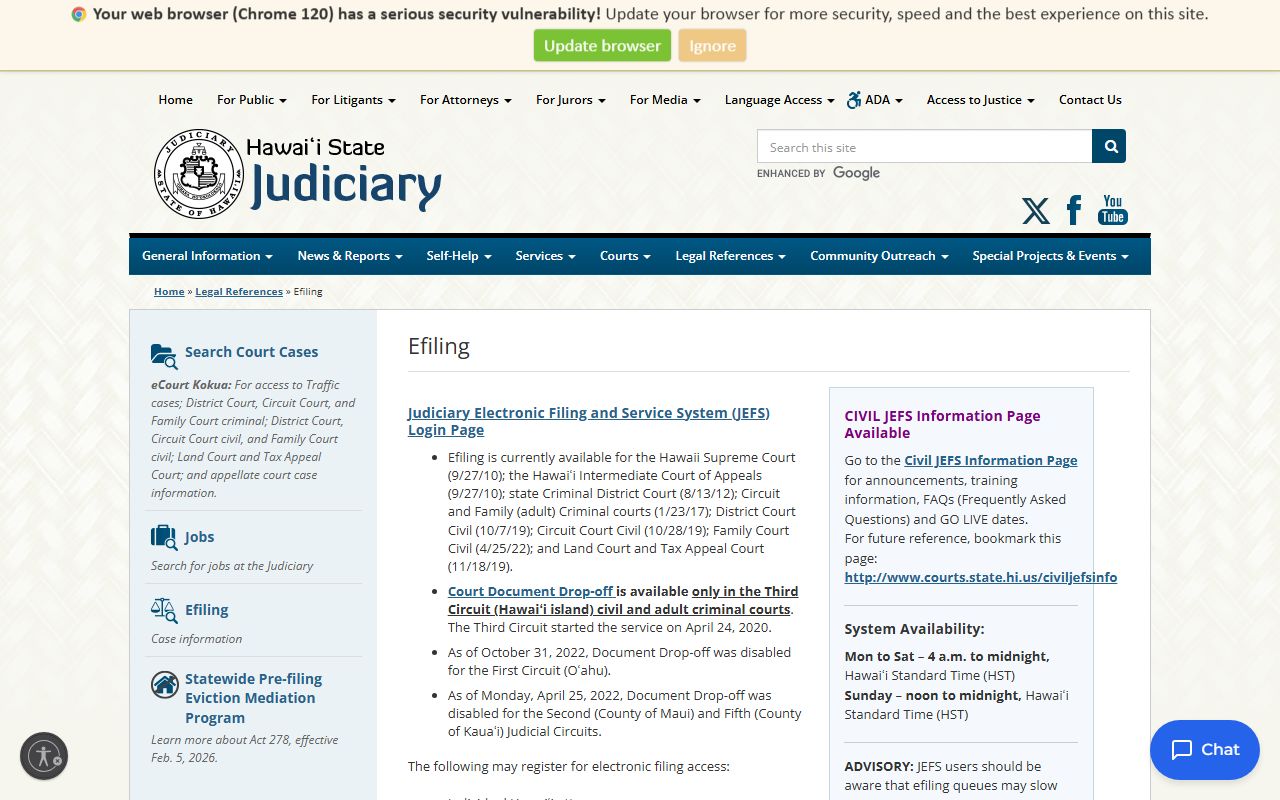
JEFS access is at courts.state.hi.us/legal_references/efiling, but note JEFS does not handle Hawaii bankruptcy records, which are federal.
Historical Hawaii Bankruptcy Records
The Hawai'i State Archives holds Judiciary Branch records from 1839 to 1970. That includes civil, criminal, marriages, divorce, equity, law, probate, wills, and estate and bankruptcy files. Clerk of the Supreme Court and First Circuit Court records between 1839 and 1926 cover administrative papers, correspondence, dockets, and notary public books. Files about estates, bankruptcies, and civil cases are arranged by plaintiff or estate name.
Some early Hawaii bankruptcy records are in both Hawaiian and English. The archives also hold oaths of district court judges, jury commissioners, and attorneys. Access to archive materials is through the Hawai'i State Archives at 364 S King Street in Honolulu. See ags.hawaii.gov/archives for hours and request procedures.
Legal Help for Hawaii Bankruptcy
You do not need a lawyer to file, but a lawyer helps a lot with complex cases. A number of free or low-cost resources serve Hawaii bankruptcy filers.
The Legal Aid Society of Hawai'i offers free civil legal help to people with low income, including some bankruptcy matters. The Volunteer Legal Services Hawai'i program pairs filers with pro bono attorneys. The court also runs a Credit Abuse Resistance Education (CARE) program, a national nonprofit community service effort. Bankruptcy judges and lawyers teach high school and college students about credit use, money basics, and how bankruptcy works. The program aims to head off future financial trouble.
Anyone filing without a lawyer must file the Certificate of Credit Counseling within 14 days of the petition. A debtor education course follows before discharge. Both courses come from U.S. Trustee-approved providers. Lists live on the U.S. Trustee site at justice.gov/ust.
Browse Hawaii Bankruptcy Records by County
Hawaii has five counties. Each one ties to a state judicial circuit but shares the single federal bankruptcy court in Honolulu. Pick a county for local courthouse, clerk, and filing details.
Hawaii Bankruptcy Records in Major Cities
Hawaii's main cities all file bankruptcy through the Honolulu federal court. Pick a city for local court and clerk info.